Framework development
Collaboration, trials and research have shaped the evolution of the GFM.
It is informed by over a decade of research, expert consultation and development, building scientific credibility and rigour. Over the past three years, over 75 farm assessments and 1,700 sustainability indicators have been analysed by GFM researchers, including a Delphi review on biodiversity indicators.
To date, the framework has been tested on over 500 farms across 23 countries to improve its usefulness, practicality and adaptability for all farming systems.
Structure
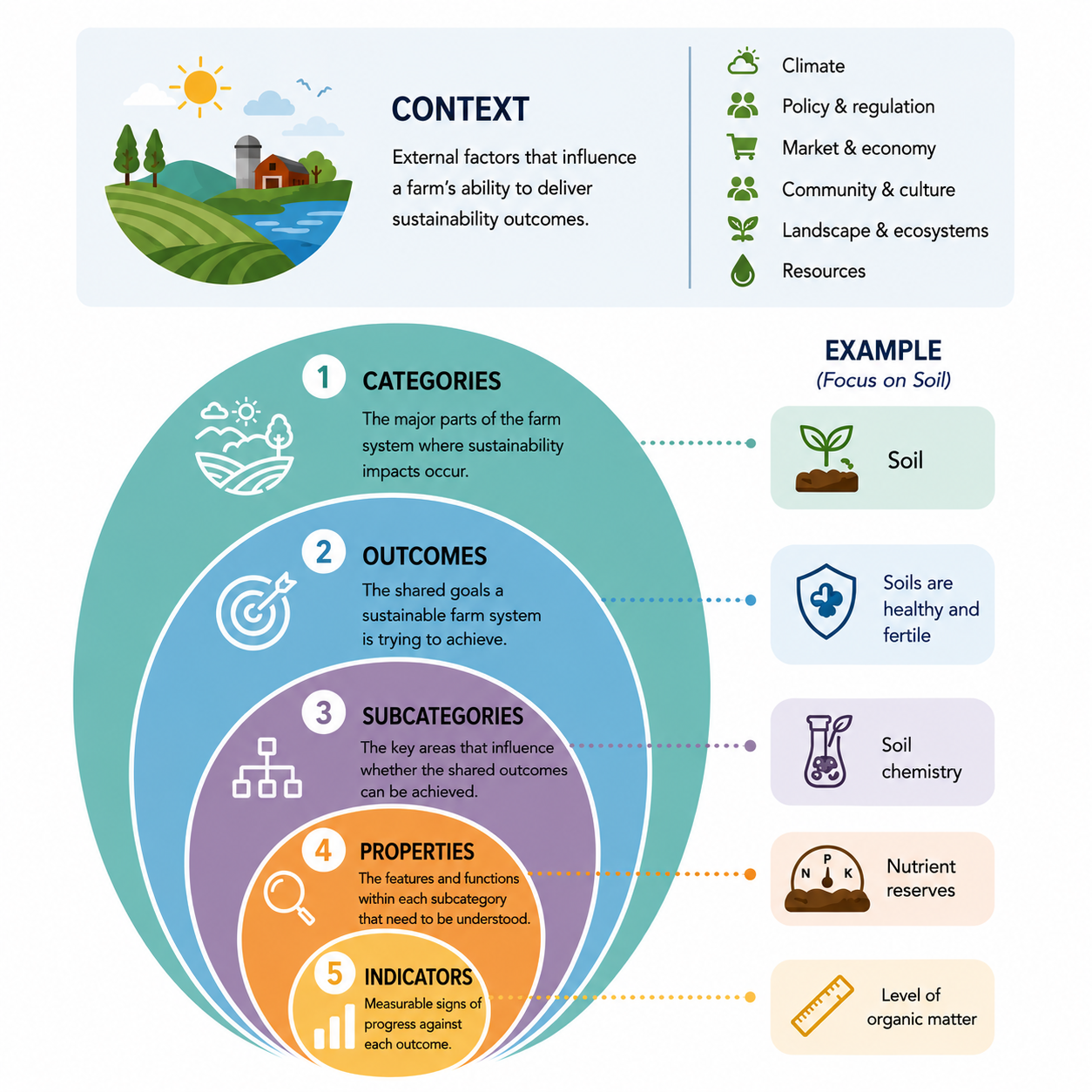
The framework breaks the key parts of a farming system down into measurable areas to provide a holistic picture across social, economic and environmental dimensions. It starts with high-level categories and outcomes, then breaks these down into subcategories and properties. Shared indicators are used to measure progress towards the desired outcomes. It recognises that all outcomes are shaped by contextual factors.
The wheel
Explore the categories and subcategories of the latest iteration of the framework, GFM2.0.